
The world’s most advanced cell balancing technologyTM
Meet the Founders

Eric Grasshoff
Eric has a BS in Physics from Texas A&M University
The inventor of True Balancing, is an EE with 55+ years of hands-on experience in design and development of electronic systems.
Eric has strong experience in analog circuit design, as well as design of digital and mixed analog/digital systems. Expertise in low-level control firmware embedded in microprocessors and microcontrollers. Extensive experience in real-world product development including military worst-case design; medical device electronics; industrial and commercial electronic systems; verification & validation (V&V) of medical device software; and industrial design-to-cost for small size, low power and low production cost.

Clint O’Conner
Clint has a AB in Applied Mathematics/Economics from Harvard University
Manages business development for True Balancing. He has 50+ years of experience managing development of new products and technologies in the fields of consumer electronics, medical devices, industrial controls, aerospace and automotive.
About the Company
How True Balancing Got Started
When we founded True Balancing we didn’t have a background in batteries or in battery management electronics – which turned out to be an advantage. Continue reading to find out why.
We first encountered out-of-balance batteries when we were working on a new product that was powered by a lithium-ion battery. The client had purchased a pallet of batteries that had been sitting in a warehouse for about year with no maintenance charging.
We connected one of the batteries to a prototype of the product and tried to power it on, and the BMS flashed a warning signal indicating bad battery. The same thing happened with two more batteries.
Rather than just telling the client they had to buy new batteries, Eric brought one the batteries back to his lab and analyzed it. He found that the battery had self-discharged to a low SOC and the individual cells had self-discharged at different rates, leaving the battery in a very out-of-balance condition. The battery was in a condition that the BMS couldn’t correct. It wouldn’t even try to charge the battery. It just flashed a signal indicating bad battery. However, none of the individual cells were dead; every one of them could hold a charge. The cells just had very different states of charge. This is a classic example of an out-of-balance battery.
A bit of research revealed that what we experienced wasn’t unique – that out-of-balance is a major problem in the battery industry.
Designing a Better Balancing Technology
That got us thinking. Is there way to design a balancing system that would allow a battery to recover from this state? Or, better yet, prevent the battery from ever getting into such an out-of-balance state? We decided to take a stab at it.
This is when not having a background in batteries or battery management proved to be a blessing. Rather than looking at existing balancing technologies and trying to figure out how to improve on them, we started with a completely clean slate. We started from first principles thinking about how we would design the ideal system for keeping batteries balanced.
We set six design goals:
- Balancing current can be as high as needed to keep any battery balanced (or restore any unbalanced battery to a balanced condition)
- Very efficient (when balancing is active, absolute minimum amount of energy is drained from the battery)
- Low cost
- Design for manufacturability (use common electronic components that are readily available from multiple sources)
- Design for system integration (can be easily integrated with any BMS and any battery)
- Design for safety and reliability (must comply with relevant regulatory standards).
Starting with these design goals, we developed True Balancing. And serendipitously (yes, I used a thesaurus), the circuit architecture of True Balancing happens to have all of the elements needed for impedance measurement.
As we continued to improve the technology, we encountered specific out-of-balance patterns in batteries that had been in real world use which inspired the development of Positive Balancing
Talks and Presentations
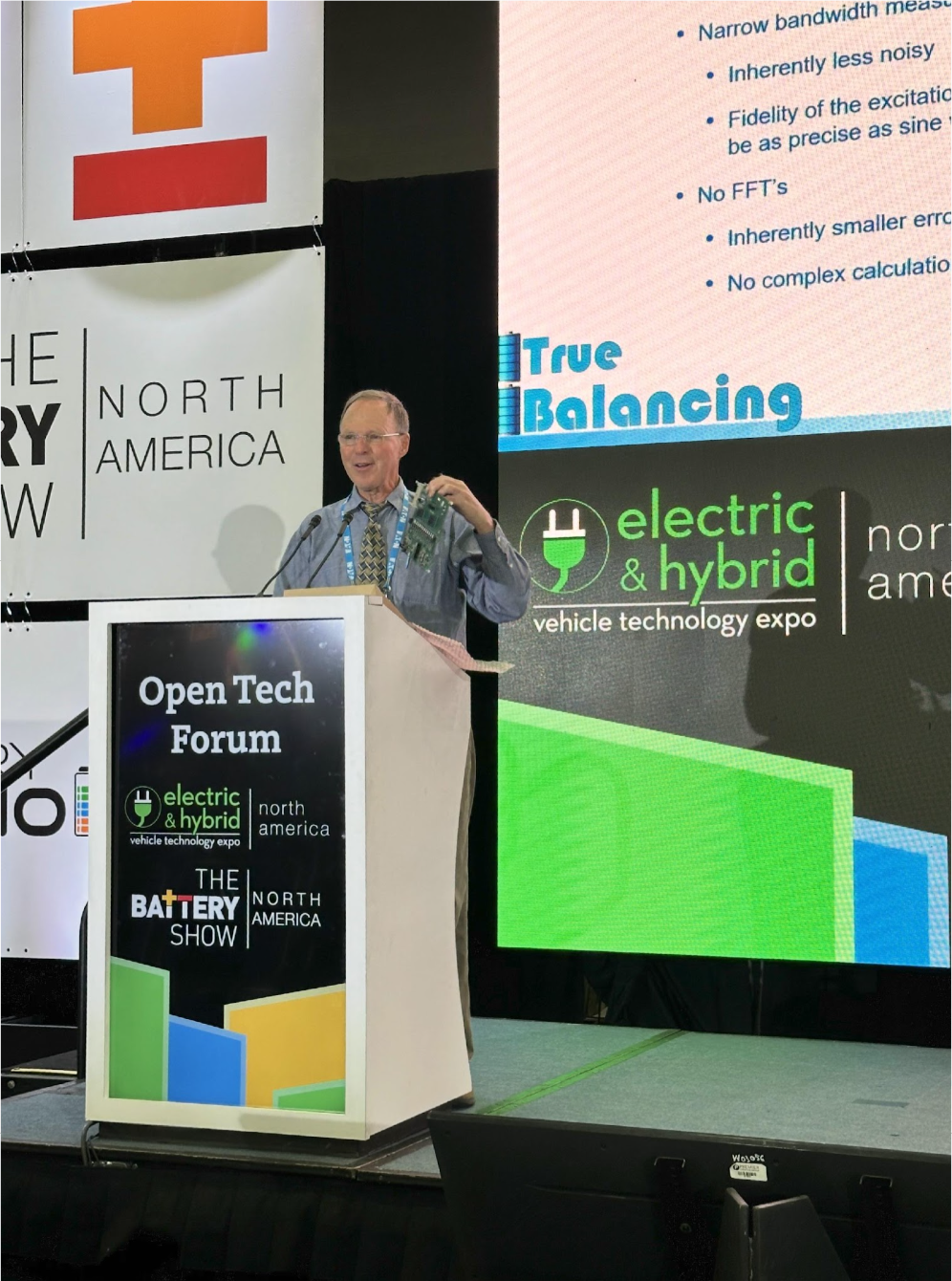
The Battery Show North America – Sept 2019
- First public presentation of the design, theory of operation, and benefits of True Balancing
The Battery Show North America – Oct 2023
- Presentation of advances and improvements in True Balancing
xEV Battery Innovation Show – Nov 2023
- Focus on environmental benefits of True Balancing
DesignCon/Drive World – Jan 2024
- First live demonstration in a public venue of True Balancing in action
The Battery Show North America – Oct 2024
- First public presentation of Positive Balancing
- Results of independent study performed by Center for Energy Research at University of California San Diego
DesignCon/Drive World – Jan 2025
- Presentation of results of tests on Tesla Model S modules
- Organized and moderated panel discussion on EV drivetrains
The Battery Saloon – April 2025
- Presentation as part of San Francisco Climate Week
The Battery Show North America – Oct 2025
- Presentation of our technology for in situ impedance measurement
Battery Innovation Summit – April 2026
- Pitch fest and poster presentation

Click here to contact us by email.
This website does not use cookies or any other tracking technology. We will only contact you if you initiate contact with us and request more information.